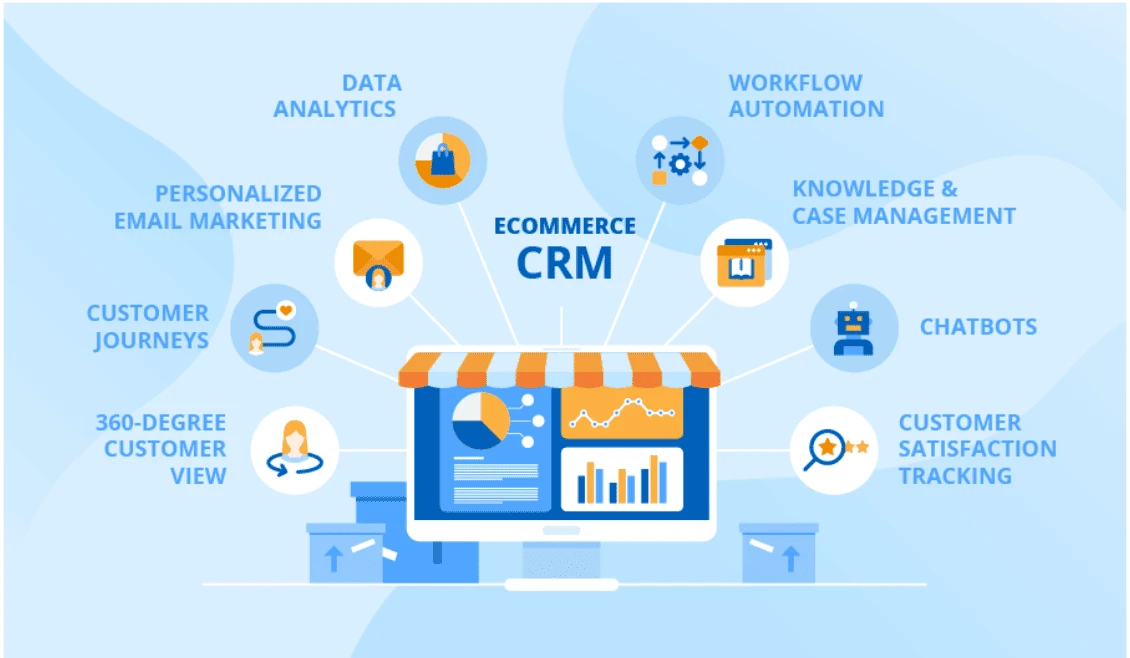
An ecommerce CRM is a specialized system designed to act as a single source of truth for customer data, behaviors, and habits. Unlike traditional B2B CRMs, it is built for high transaction volumes and rapid behavioral triggers, allowing online stores to replace guesswork with precise data on customer lifetime value and omnichannel interactions. Vtiger claims that for e-commerce businesses, a CRM is no longer optional for scaling in a competitive digital market.
How Ecommerce CRM Differs from Traditional B2B Systems
Ecommerce CRMs differ from traditional B2B CRMs by focusing on high transaction volumes and rapid behavioral triggers (firing in minutes) rather than long sales cycles. They analyze real-time site metrics like conversion rates and click-through rates to manage anonymous-to-known buyer journeys across multiple digital channels.
Traditional CRM systems are generally designed to manage a pipeline where a small number of high-value leads are nurtured over weeks or months. In contrast, ecommerce operations require a system that can handle thousands of micro-interactions. This includes tracking the “anonymous-to-known” journey, where a visitor’s behavior is tracked before they ever create an account or make a purchase.
Beyond basic contact management, e-CRM software analyzes specific website metrics that traditional systems ignore. According to Sana Commerce, these include customer click-through rates, email subscription opt-ins, conversion rates, and the specific products that attract customer interest. This allows operators to move away from the guesswork associated with lacking physical visibility into their customers.
Criterion |
Traditional B2B CRM |
Ecommerce CRM (e-CRM) |
|---|---|---|
Sales Cycle |
Long-term lead nurturing |
High-volume, rapid transactions |
Trigger Speed |
Weeks or months |
Minutes (behavioral triggers) |
Primary Metrics |
Pipeline stage, deal value |
CTR, conversion rates, opt-ins |
Customer Journey |
Known lead to closed-won |
Anonymous visitor to known buyer |
This operational shift allows businesses to score customers by lifetime value, which informs where marketing budgets and staff attention should be prioritized.
Native Store Tools vs. Dedicated External CRMs
Choose a native store CRM (like Shopify’s built-in tools) for low SKU counts (under 100) and simple order volumes. Switch to a dedicated external CRM (like Zoho or Insightly) when you scale beyond these thresholds or require advanced RFM scoring, complex project management, or a unified identity across multiple sales channels like wholesale and retail pop-ups.
Native tools provided by platforms like Shopify or WooCommerce are effective for automating basic follow-ups and managing loyalty programs. However, businesses often outgrow these tools when they expand their sales channels. A critical pitfall occurs when a business adds wholesale, retail pop-ups, or third-party marketplaces without a dedicated CRM; this often causes the customer identity to fragment, forcing the business to start from scratch on each new channel.
Dedicated external CRMs provide a unified identity that ensures a customer’s first interaction on a new channel inherits their full relationship history. For those requiring high levels of customization or advanced lead scoring, external tools offer capabilities that native plugins cannot match without extensive custom development.
Criterion |
Native Store CRM |
External Ecommerce CRM |
|---|---|---|
Operational Focus |
Store-specific order management |
Omnichannel customer experience |
Scalability |
Limited to platform ecosystem |
High; supports complex workflows |
Channel Unification |
Siloed by store |
Unified across retail, web, and wholesale |
Feature Depth |
Basic profiles and tags |
RFM scoring, CLV, project management |
The decision to migrate depends on whether the business requires a simple database of orders or a strategic tool for behavioral segmentation and long-term retention.
The Logic of Ecommerce Customer Management
Effective customer management in ecommerce follows a linear progression from raw data capture to automated retention strategies. This process eliminates the gap between a customer’s action on a website and the business’s response.
The operational workflow typically follows these stages:
- Data Collection: Gathering information from all digital touchpoints, including website visits, product views, order history, payment methods, and live chat interactions.
- Profile Creation: Organizing collected data into detailed profiles that include personal details, preferences, and a history of all support tickets.
- Automation Setup: Configuring rules for welcome emails, cart abandonment alerts, and personalized offers triggered by new sign-ups, repeat purchases, or periods of inactivity.
- Omnichannel Optimization: Compiling interactions from email, mobile, SMS, and social media into a single holistic profile to ensure a consistent experience across all touchpoints.
By mapping out the steps decision-makers take during the purchase process, businesses can assign prospects by their likelihood of transaction and analyze specific friction points to improve overall conversion rates.
Technical Integration Warnings and Pitfalls
Integration is the most volatile phase of CRM implementation. Many businesses experience “ghost data” or synchronization failures because they overlook the technical constraints of their ecommerce platform’s API, such as rate limits that throttle data flow during peak traffic or sync latency that delays customer profile updates by several hours, leading to outdated automation triggers.
Beyond API limits, functionality often breaks when businesses choose a CRM that lacks native connectors for their specific platform. Relying on significant custom development for RFM (Recency, Frequency, Monetary) or CLV (Customer Lifetime Value) scoring often leads to unstable systems that break during platform updates.
Finally, technical success is often undermined by human error. Poor employee training and a failure to maintain accurate, complete data entries can render the most expensive CRM useless, as the automation triggers will be based on flawed or missing information.
Recommended CRM Options by Business Stage
The ideal CRM choice depends on the current scale of the business and the complexity of the required workflows. Startups generally require lightweight tools, while scaling enterprises need deep customization.
- Startups: Vtiger CRM and Freshmarketer are recommended as lightweight options for businesses just beginning to move away from spreadsheets.
- Scaling and Mid-Market: Zoho CRM is a highly customizable option featuring automation and support for a wide range of business sizes. It includes Zia, an AI-powered lead scoring tool that helps prioritize high-value prospects. The standard plan starts at 14 USD per user per month, and a 15-day free trial is available. It maintains an average user rating of 4.4 stars.
- Enterprise and Project-Heavy: Insightly is suited for mid-to-large businesses that require integrated project management and workflow automation alongside their customer data. It holds an average user rating of 4.5 stars.
For those using Magento, native plugins for Zoho CRM are available to streamline the connection process.
FAQ
What is the difference between an ERP and a CRM for ecommerce?
An ERP (Enterprise Resource Planning) system focuses on back-office functions such as HR, finance, and inventory management. In contrast, a CRM is dedicated specifically to housing and managing customer data to drive sales and marketing efforts.
Can a CRM help with inventory management?
Yes. By integrating a CRM, businesses can improve inventory management by aligning real-time customer demand data and behavioral trends with current stock levels to optimize ordering.
How does AI improve ecommerce CRM performance?
AI tools, such as Zia within Zoho CRM, provide AI-powered lead scoring. This allows businesses to automatically identify and prioritize high-value prospects based on data patterns rather than manual sorting.