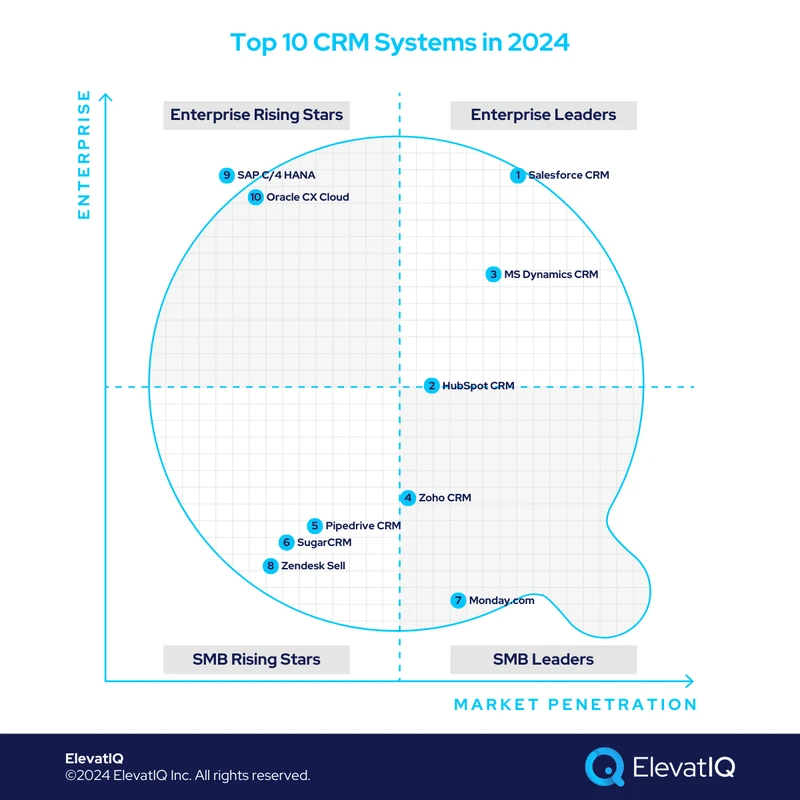
An enterprise cloud CRM is not defined by seat counts or feature checklists, but by governance depth, multi-entity isolation, and its capacity to integrate natively with core ERP and transactional systems without brittle custom middleware. As enterprise software consultancy Clarity observes, enterprise CRM infrastructure must support thousands of users, complex role hierarchies, and multi-entity data architectures while coordinating deeply with ERP, eCommerce, and support systems. Organizations transitioning from mid-market sales tracking tools to enterprise cloud platforms encounter a structural reality where base subscription licensing represents only a fraction of total architecture expense. Selecting an enterprise platform architecture dictates whether an organization establishes an agile operational core or creates long-term technical debt across departmental silos.
What Separates Enterprise Cloud CRM from Standard Software
An enterprise cloud CRM is customer relationship management infrastructure designed for large-scale organizations with complex governance requirements. Unlike mid-market CRM software, enterprise platforms provide multi-entity data partitioning, strict role-based permissions, regional compliance hosting, and deep two-way integration with backend ERP, finance, and supply chain systems across thousands of concurrent users.
Enterprise consultancy Insightly positions 500 or more employees as the threshold where mid-market platforms fail under operational weight. Below this scale, sales teams often tolerate manual record consolidation and generic user permissions. At enterprise scale, organizations require systematic workflow automation to coordinate business units. According to industry analysts, enterprise CRM systems automate routine tasks across lead routing, opportunity management, service ticket tracking, and multi-departmental sales reporting, mitigating human error while enforcing standard operating procedures.
Governance and data isolation represent the most significant architectural divide between mid-market and enterprise systems. Standard commercial tools host client data in pooled multi-tenant configurations with basic security policies. Regulated enterprises deploying platforms without field-level permission controls, comprehensive audit logging, and localized data residency face severe operational and regulatory exposure. By contrast, specialized platforms demonstrate how dedicated database isolation solves compliance concerns. For instance, Technolutions Slate—an enterprise platform supporting over 2,000 colleges and universities across a 25-year operational history—houses each client organization within its own private database to ensure data is never commingled, maintaining an unbreached security record with zero major outages.
- Multi-Entity Hierarchy Management: Partitioning customer accounts, territories, and transactional records across international operating subsidiaries while consolidating executive reporting.
- Granular Role-Based Permissions: Enforcing object, record, and field-level security boundaries to prevent unauthorized internal visibility into sensitive account data.
- Automated Compliance Governance: Maintaining immutable system audit logs, encryption at rest and in transit, and localized regional data residency to satisfy global regulatory requirements.
- High-Throughput Integration Engines: Exchanging mission-critical account, order, and billing data bi-directionally with financial ledgers, inventory systems, and core data lakes.
Leading Enterprise Platforms: Architecture and Ecosystem Fit
Enterprise cloud CRM platforms diverge across their architectural ecosystems: Salesforce prioritizes vast extensibility with over 8,000 AppExchange apps and Agentforce AI; Microsoft Dynamics 365 anchors directly into Office 365 and native ERP; Creatio offers agentic no-code composability across 20+ sectors; and SAP Sales Cloud ties natively into complex SAP back-office operations.
Evaluating enterprise platforms requires matching core architectural strengths to existing operational infrastructure. The table below benchmarks leading enterprise systems across architecture, standard enterprise list pricing, user satisfaction, and primary integration parameters.
Platform |
Core Architectural Strength |
Entry Enterprise Pricing (Seat/Mo) |
G2 Rating |
Primary Integration Consideration |
|---|---|---|---|---|
Salesforce |
Extensive partner ecosystem and advanced cross-object reporting |
$175 (Salesforce Enterprise) |
4.4 / 5 |
Requires custom middleware to bridge front-office sales with non-Salesforce backend ERPs |
Microsoft Dynamics 365 |
Native data unification with Microsoft 365, Teams, and Dataverse |
$105 (Sales Enterprise) |
Evaluated via ecosystem |
Direct shared data models with Dynamics 365 Finance and Supply Chain Management |
Creatio |
Agentic no-code architecture with composable workflow blocks |
$100+ (tier-based) |
4.7 / 5 |
Pre-packaged vertical models across 20+ industries with dual cloud or on-premise hosting |
SAP Sales Cloud |
Deep bidirectional operational coupling with the SAP back-office core |
$138 |
Evaluated via ecosystem |
Native transactional synchronization for enterprises already standardized on SAP ERP |
While published seat pricing establishes baseline operating expenses, ecosystem architecture dictates actual deployment complexity, development velocity, and long-term custom engineering overhead.
Salesforce and Dynamics 365: Ecosystem Breadth vs Native ERP Cohesion
Salesforce functions as the enterprise benchmark for extensibility, powered by more than 8,000 certified integrations in the AppExchange marketplace and enterprise orchestration tools like Salesforce Flow. For complex organizations requiring custom business logic, Salesforce provides cross-object reporting capabilities and integrated Agentforce AI agents to automate customer-facing service workflows. However, enterprise implementation analysis highlights a structural boundary: Salesforce specializes strictly in front-office customer engagement. Organizations running Salesforce Field Service or Sales Cloud must construct and maintain custom integrations or third-party connectors to feed operational data into external accounting, general ledger, and fulfillment systems.
Microsoft Dynamics 365 approaches enterprise sales operations from a unified organizational framework. Grounded in the Microsoft Dataverse, Dynamics 365 pairs front-office CRM functionality with backend enterprise ERP modules. Account managers and service personnel access live customer records, inventory data, and opportunity stages directly inside Microsoft Outlook, Teams, and Excel. This native alignment eliminates synchronization layers for organizations utilizing Microsoft operating tools, enabling sales representatives to review credit approvals and delivery timelines without leaving their primary workspace.
Creatio and SAP Sales Cloud: Agentic Composability vs Back-Office Depth
Creatio distinguishes itself through an agentic, no-code architecture that holds a 4.7 out of 5 satisfaction rating on G2, compared to Salesforce’s 4.4 out of 5. The platform allows business analysts and enterprise architects to assemble tailored operational workflows across more than 20 specialized industry sectors without writing custom backend code. Creatio also provides enterprise architectural flexibility by offering deployment across both cloud and on-premises environments, supported by 24/7 enterprise SLAs, regional data residency, and field-level encryption for compliance-heavy organizations.
SAP Sales Cloud targets organizations centered on an SAP corporate backbone. According to Clarity, SAP Sales Cloud delivers maximum value when sales execution, pricing structures, quote validation, and contract history must align directly with structured back-office financial processes. When an organization’s core operations run on SAP, deploying SAP Sales Cloud removes the synchronization friction typically required to reconcile sales orders, stock reservations, and client credit balances against third-party CRM tables.
Integration Realities: Governor Limits, Throttling, and Zero-Copy
High-volume transactional integration represents the most common operational failure mode in enterprise cloud CRM deployments. Multi-tenant cloud platforms maintain system performance by enforcing daily API request quotas and real-time execution limits. When connected systems—such as ERP platforms, billing software, or warehouse management databases—attempt to push high-frequency updates or mass nightly batches via standard REST or SOAP endpoints, they frequently exceed vendor governor limits. Once service protection limits are breached, incoming calls return HTTP 429 throttling errors, data pipelines stall, and pending updates drop into unmonitored dead-letter queues.
Asynchronous data queuing creates secondary operational vulnerabilities. When batch data transfers lag behind operational velocity, field service dispatchers view stale inventory balances, customer service agents address tickets with outdated billing statuses, and sales personnel duplicate account outreach. These data discrepancies undermine user confidence and introduce operational errors into client fulfillment pipelines.
To eliminate brittle point-to-point extract, transform, and load (ETL) routines, enterprise architects are transitioning toward zero-copy lakehouse architectures. Under a zero-copy model, the cloud CRM queries enterprise data platforms—such as Snowflake, Databricks, or Microsoft Fabric OneLake—directly in place using open file formats like Apache Iceberg and Delta Lake. By querying unified lakehouse records rather than moving duplicate datasets across network boundaries, the enterprise bypasses API governor limits, avoids duplicate storage fees, and provides customer-facing teams with real-time operational visibility.
The Hidden Cost of Architecture: Licensing Tiers vs True TCO
Base software licenses represent only a portion of the Total Cost of Architecture (TCA). Subscriptions escalate significantly as organizations upgrade tiers to access enterprise-grade governance, custom objects, and advanced workflow automation. Microsoft Dynamics 365 Sales Enterprise lists at $105 per user per month, with its Sales Premium tier priced at $150. Salesforce Enterprise begins at $175 per user per month billed annually, climbing to $550 per user per month for its Agentforce 1 Sales edition, while SAP Sales Cloud is publicly positioned at approximately $138 per user per month. Lower-tier platforms or mid-market offerings like Zoho CRM provide pricing discounts—such as 34% cost savings on annual billing plans compared to monthly rates—while lightweight platforms like SugarCRM mandate user minimums, such as a 15-user threshold on its Core tier. However, for organizations with 500 or more employees, subscription fees represent just the initial layer of financial investment.
500-Seat Total Cost of Architecture (TCA) Decision Framework
For an organization evaluating 500 seats, software licensing represents only the foundation of the Total Cost of Architecture (TCA). An architectural evaluation must quantify annual subscription commitments against implementation retainers, API rate limit overhead, and storage expansion across platform tiers.
Platform and License Tier |
Annual Base Licensing (500 Seats) |
Implementation and Consultant Retainers |
API Rate Limit and Integration Governance |
Storage and Infrastructure Cost Drivers |
|---|---|---|---|---|
Microsoft Dynamics 365 Sales Enterprise ($105/seat/month) |
$630,000 |
Partner integration focused on Dataverse and ERP; eliminates custom middleware retainers for Microsoft 365 environments. |
Native operational synchronization with Dynamics 365 ERP; zero-copy Microsoft Fabric OneLake queries bypass external API rate limits. |
Capacity managed across Dataverse tiers; cold-storage archiving to corporate data lakes mitigates proprietary database surcharges. |
Salesforce Enterprise ($175/seat/month) |
$1,050,000 |
8 to 16 weeks implementation duration; mandates certified third-party technical partners and dedicated internal platform administrators. |
Enforces daily REST and SOAP governor limits; high-frequency ERP updates risk HTTP 429 throttling without dedicated middleware queues. |
Restrictive default per-seat database caps; audit logs, transactional history, and attachments trigger tiered storage upgrade fees. |
Salesforce Agentforce 1 Sales ($550/seat/month) |
$3,300,000 |
Extended systems integrator retainers for autonomous AI agent configuration, data model alignment, and ongoing administration. |
Real-time autonomous agent actions and cross-object queries demand active API governor limit monitoring and infrastructure buffers. |
Elevated telemetry and agent interaction logging accelerate database consumption, necessitating zero-copy lakehouse architectures. |
SAP Sales Cloud ($138/seat/month) |
$828,000 |
Certified SAP systems integrators required to coordinate pricing rules, quote validation, and back-office order processes. |
Native bidirectional synchronization with the SAP core operational landscape bypasses third-party middleware and API constraints. |
Transactional records anchor directly into back-office ERP tables, preventing redundant CRM database storage accumulation. |
Creatio ($100+/seat/month tier-based) |
$600,000+ |
Agentic no-code composability across 20+ sectors allows in-house business analysts to build workflows, reducing external developer retainers. |
Configurable API throughput supported by 24/7 enterprise SLAs and dual deployment flexibility across cloud and on-premises environments. |
Deployment flexibility across cloud and on-premise environments provides regional data residency and predictable database costs. |
As Insightly executive Val Riley notes, selecting an incompatible platform architecture leads to months of deployment friction, runaway consultant expenses, and unused functionality. A typical Salesforce implementation spans 8 to 16 weeks and necessitates certified third-party technical implementation partners to configure custom data schemas, validate security boundaries, and build workflow logic. Beyond external integrators, running an enterprise-scale CRM requires dedicated internal administrative staff to handle ongoing release cycles, user permissions, and schema updates.
- Specialized Implementation and Retainer Costs: Third-party systems integrators and development partners required to design custom objects, refactor legacy integrations, and manage complex system rollouts.
- Internal Certified Platform Headcount: Dedicated internal system administrators and solution architects to oversee security governance, release sandboxes, and permission sets.
- Sandbox Environment Tiers: Premium full-copy sandbox environments required to stage, test, and validate quarterly vendor platform updates against live data schemas without risking production outages.
- Production Data Storage Expansion: Incremental storage surcharges incurred when historical transaction records, audit logs, and client attachments exceed restrictive default database allocations.
Storage pricing traps catch enterprises off guard as record volumes multiply. Cloud CRM platforms bundle nominal database and file storage allocations per seat. Once telemetry data, client correspondence, and billing records expand beyond baseline caps, vendors assess steep storage upgrade fees. Preventing these compounding expenses requires enterprise architects to establish aggressive cold-storage archiving policies and zero-copy data strategies early in platform deployment.
How to Validate and Pilot an Enterprise CRM Rollout
Mitigating architectural risk requires enterprise procurement teams to validate platform performance against real-world operations prior to signing multi-year agreements. Rather than relying on generic vendor demonstrations in sanitized sandbox environments, evaluation committees should execute full deal-cycle pilots. This technique routes active sales leads through complex routing rules, generates multi-line item quotes requiring dynamic approvals, issues downstream billing triggers, and verifies audit trail logging under realistic operating conditions.
Validating external engagement layers is equally critical when evaluating platform fit. Solutions like Salesforce Experience Cloud and Microsoft Power Pages allow organizations to deploy branded, external-facing web portals tied directly to underlying CRM records. These community portals enable partners and clients to manage cases, view service tickets, and update documentation independently. Technical evaluators must audit how these portal builders manage authenticated user sessions, role-based record visibility, and external license consumption to prevent governance gaps or licensing surprises.
- Audit Custom Object Architecture: Restrict custom object and field creation to prevent system bloat, protect database query speeds, and maintain interface usability.
- Enforce Interface Simplification: Design role-specific page layouts that display only the fields and action buttons required for daily tasks, minimizing cognitive overhead for field teams.
- Test Offline Sync and Data Collision Rules: Evaluate how mobile client applications handle offline field updates and resolve record conflicts when remote personnel reconnect to enterprise networks.
- Establish Contractual Egress and API Rights: Negotiate guaranteed rate caps for API usage surges, verify data extraction rights upon contract completion, and fix sandbox pricing across multi-year renewal cycles.
Modern mid-market platforms are also expanding their enterprise governance footprint. Platforms like HubSpot, through its Sales Hub Enterprise tier, provide custom objects, role controls, conversation intelligence, and AI-powered lead scoring to compete for larger deployments. Regardless of whether an organization chooses Salesforce, Microsoft Dynamics 365, Creatio, SAP Sales Cloud, or HubSpot, the pilot must validate that the platform supports existing business processes without requiring unsustainable custom code or administrative overhead.
FAQ
How do zero-copy data architectures change enterprise cloud CRM integration?
Zero-copy architectures allow cloud CRMs to query enterprise data lakes like Snowflake or Databricks directly without extracting, transforming, or replicating datasets. This eliminates API rate limits, lowers storage expansion fees, and ensures CRM dashboards access real-time operational records without batch synchronization lags.
What happens when an enterprise CRM exceeds its daily API governor limits?
When daily API governor limits or throttling thresholds are breached, incoming calls from connected systems like ERP or billing engines are queued or rejected. This results in delayed record synchronization, order fulfillment stalls, and field personnel viewing stale account data until request quotas reset.
Why do enterprise CRM implementations require full-time administrators?
Unlike lightweight software, enterprise CRMs feature custom data schemas, cross-object flows, strict role hierarchies, and complex integration endpoints. Managing continuous regulatory updates, user permission auditing, sandbox releases, and custom code necessitates dedicated certified system administrators.
How does single-tenant database isolation compare to multi-tenant cloud hosting?
Multi-tenant cloud architectures pool resources across shared servers with logical software partitioning, lowering infrastructure costs. Single-tenant isolation, exemplified by specialized platforms like Technolutions Slate, houses each organization in an independent physical or virtual database, eliminating co-mingling risks and simplifying regulatory compliance.