For most US small businesses, the best CRM choices in 2026 come down to operational focus: Bigin by Zoho CRM is the top budget pick for micro-teams needing fast setup; Zoho CRM leads for comprehensive task automation; Salesmate excels for contact-heavy outreach with unlimited contact caps; Monday CRM offers unmatched visual pipeline customization; and Salesforce Starter delivers turn-key sales and service AI without enterprise complexity.
Data from the Small Business Administration establishes that 30 million small businesses generate 54% of all U.S. sales and account for 99% of American employers. Operating at that scale requires moving past disjointed spreadsheets and missed follow-ups. Research published by Nucleus Research shows that companies earn an average return of $8.71 for every dollar invested in CRM software. Reaping those gains requires matching software architecture directly to practical sales workflows rather than overpaying for unused technical capacity.
What Actually Matters in a Small Business CRM
The best small business CRM prioritizes usability over endless feature lists. Key selection criteria include sub-hour team onboarding, two-way integration with US accounting tools like QuickBooks, transparent pricing without aggressive contact-tier penalties, and automated compliance for SMS outreach such as A2P 10DLC registration and TCPA consent tracking.
Research published by SuperOffice indicates that 91% of companies with more than 11 employees rely on a CRM system. Despite high adoption rates across growing businesses, smaller operations frequently fail during implementation by purchasing platforms designed for large corporations. As Kiryl Drabysheuski, Lead of ERP Consultants at Innowise, observed:
“Usability beats flashiness. The best CRMs for small teams are simple to adopt, easy to customize, and free from unnecessary complexity.”
When software demands weeks of custom administrative scripting, internal sales representatives stop recording customer touchpoints. Evaluating software through an operational lens keeps teams productive. Ross Peetoom, VP Professional Services at Faye, summarized the core selection rule:
“The best CRM for a small business is the one that fits your team today and scales with you: HubSpot for an easy free start, Pipedrive for straightforward pipeline management, Salesforce for power and ecosystem, and SugarCRM for deep customization.”
Evaluating potential platforms requires focusing on concrete structural benchmarks:
- Sub-Hour Team Onboarding: Field representatives and account managers must be able to log activities, navigate pipeline stages, and update contacts without days of formal software training.
- Financial Stack Interoperability: Bidirectional synchronization with accounting platforms like QuickBooks Online, alongside merchant payment gateways, eliminates manual billing reconciliation.
- Automated Telecommunications Compliance: Native registration frameworks for US A2P 10DLC messaging rules and built-in TCPA consent logs protect outbound marketing campaigns from sudden carrier blocks.
- Predictable Database Expansion: Subscription agreements must maintain transparent pricing tiers that do not penalize operations as their customer address books expand.
The 5 Best Small Business CRMs by Use Case
The top five CRMs for US small businesses are Bigin by Zoho CRM (best for budget micro-teams at up to $21/user/month), Zoho CRM (best for task management and automated workflows), Salesmate (best for contact-heavy operations with unlimited contacts), Monday CRM (best for visual project dashboards), and Salesforce Starter (best for built-in agentic AI).
Bigin by Zoho CRM: Best for Budget-Conscious Micro-Teams
Forbes Advisor awarded Bigin a 4.6-star rating, identifying it as an exceptional option for commercial operations working with lean software budgets. Pricing structures range from an initial free plan up to $21 per user per month for the most feature-packed tier under annual billing. Setup requires 30 minutes or less, allowing owners to move away from spreadsheets without pausing sales outreach. Bigin organizes sales activities through clean visual pipelines, call logging, and customer activity histories, focusing strictly on core pipeline execution rather than extraneous corporate administration.
Zoho CRM: Best for End-to-End Task and Process Automation
Zoho CRM holds a 4.8-star rating from Forbes Advisor and serves companies requiring automated operational workflows across sales, marketing, and order fulfillment. The platform utilizes kanban boards and structured task lists to help managers assign follow-up duties, automate lead qualification rules, and monitor deal velocity. Customer implementation data published by Zoho CRM demonstrates measurable operational gains, including a 65% increase in active sales pipelines alongside a 60% reduction in lead-to-prospect conversion time. These structured controls make it well-suited for businesses managing multiple handoffs between initial contact and deal closing.
Salesmate: Best for High-Volume Contact Management
Salesmate solves a structural cost penalty common to software pricing: artificial database limits. While conventional platforms charge steep tier upgrades as stored lead numbers increase, Salesmate permits users to maintain unlimited contacts across its primary subscription plans. This feature delivers clear cost stability for real estate brokerages, trade contractors, and B2B agencies that manage extensive client lists. Salesmate combines this contact flexibility with customizable interface layouts and email sequence tracking.
Monday CRM: Best for Visual Pipelines and Custom Dashboards
Monday CRM adapts the Monday.com Work OS engine into a visual sales environment. A central operational advantage is that Monday CRM grants full dashboard access across every subscription plan. Small operations do not face tier paywalls when building visual reports for weekly cash flows, lead sources, and individual representative performance. The visual drag-and-drop board structure suits teams that manage customer accounts through synchronized stages encompassing sales, billing, and project delivery.
Salesforce Starter: Best for Turn-Key Sales, Service, and AI
Salesforce Starter provides small businesses with access to the Salesforce technology ecosystem without the administrative friction of enterprise deployments. The platform consolidates lead tracking, email marketing, support ticketing, and agentic AI capabilities into a unified operational console. Built-in artificial intelligence assists sales representatives by drafting email responses, summarizing client interactions, and prioritizing high-intent inquiries. It delivers a direct growth path for ambitious companies that plan to scale into mid-market operations without replatforming their customer databases.
Budget and Free-Tier Options for Lean Teams
Founders running bootstrap startups or micro-teams with basic tracking needs can stabilize their sales pipelines using dedicated free or entry-level solutions that minimize overhead.
Agile CRM and Freshsales: Generous User Caps and Support
Agile CRM provides a dedicated free plan accommodating up to 10 users, making it a viable starting point for multi-person teams seeking baseline pipeline visibility. The free tier bundles contact tracking, lead scoring, deal milestones, and up to 5,000 branded marketing emails per month. This allows early-stage companies to execute coordinated outreach campaigns without incurring immediate software costs.
Freshsales takes a distinct approach to zero-cost software by bundling comprehensive assistance into its entry tier. While most software vendors restrict free users to self-help forums or automated chatbots, the Freshsales free plan supports up to 3 users and includes 24/5 multi-channel technical support spanning phone, live chat, and email. For non-technical teams that require immediate troubleshooting during initial pipeline setup, this support model prevents workflow stalls.
Bitrix24 and ConvergeHub: Integrated Workspaces and Lead Intelligence
Bitrix24 addresses the needs of distributed teams by integrating unified communications, project management boards, and sales pipelines into a single interface. Unlike many small business platforms that function exclusively as multi-tenant cloud services, Bitrix24 offers both cloud-hosted and on-premises deployment configurations. Paid subscription options start at $49 per month for five users when paid annually, providing a cost-effective flat-rate model for operations seeking on-premise data governance.
ConvergeHub delivers an entry-level tier combining sales automation, customer support ticket management, and native email marketing. The platform incorporates artificial intelligence tools that automatically prioritize incoming leads based on engagement levels, helping small sales units focus outreach hours on prospects showing active buying intent.
HubSpot Free: Seamless Starting Foundation Without Data Re-Migration
HubSpot CRM provides entry-level deal pipelines, contact tracking, and website form integration at zero cost. The structural advantage of this entry tier is data permanence: when an expanding business outgrows free functionality, upgrading to the Starter Customer Platform layers advanced sales, marketing, and service automation directly on top of the existing Smart CRM foundation. Companies avoid the operational disruption of exporting custom fields, cleaning CSV tables, and mapping historical records to a secondary CRM provider.
Teams with specific architectural constraints have additional entry points. Vtiger supports up to 3,000 contacts on its free plan, while Less Annoying CRM offers low-cost, browser-based contact management designed for business owners seeking rapid setup without complex administrative settings.
The Growth Tax: Evaluating 3-Year TCO and US Compliance
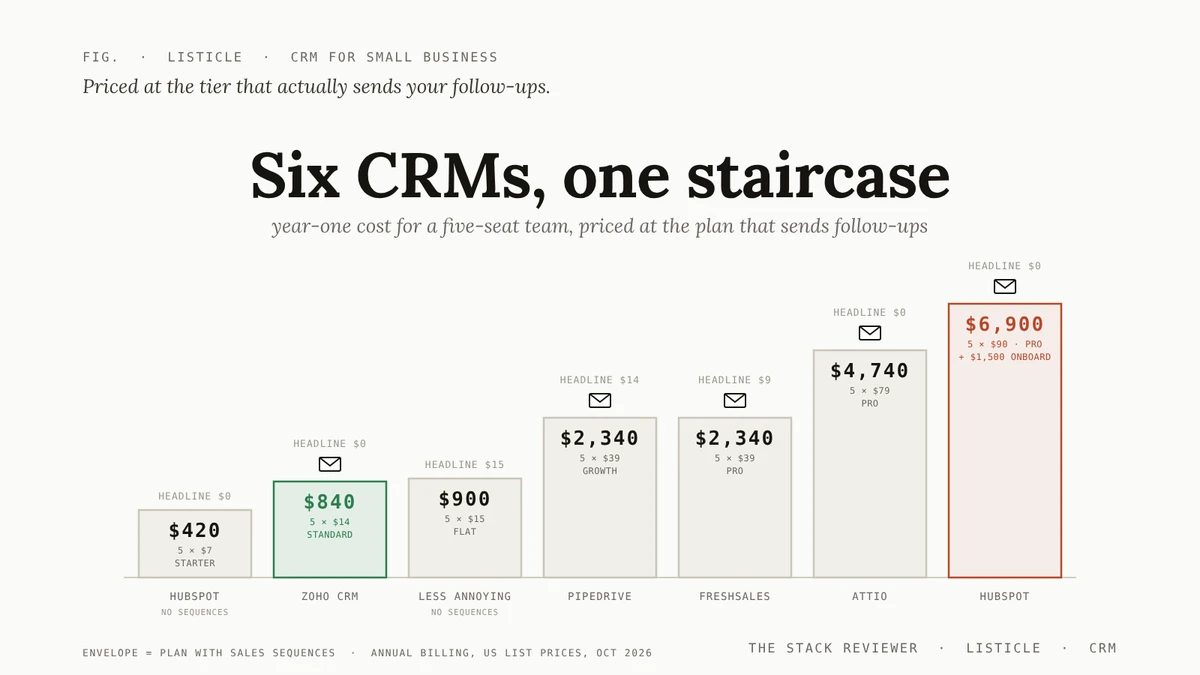
Evaluating software costs purely on introductory per-seat licensing creates severe budget distortions. A pragmatic three-year Total Cost of Ownership (TCO) evaluation requires measuring contact-tier cost escalations, onboarding fees, native A2P 10DLC SMS registration handling, and bidirectional QuickBooks Online integration across each recommended platform:
CRM Software |
3-Year TCO Cost Projection & Contact Scaling |
Onboarding & Implementation Fees |
Native A2P 10DLC SMS Registration |
QuickBooks Online Integration |
|---|---|---|---|---|
Bigin by Zoho CRM |
$21 per user per month ($756 per seat over 3 years); no contact-tier penalty multipliers |
$0 onboarding fees; setup completed in 30 minutes or less without IT assistance |
Requires third-party telephony add-on for carrier registration |
Connects via Zoho accounting integrations for invoice and contact synchronization |
Zoho CRM |
Predictable tier-based pricing; task and process automation without contact-tier penalties |
$0 mandatory onboarding fees; gradual phased rollout avoids consulting expenses |
Native carrier registration workflow and TCPA consent tracking |
Native bidirectional synchronization for contacts, invoices, and payment statuses |
Salesmate |
Predictable per-seat subscription; unlimited contacts eliminate database expansion penalties over 3 years |
$0 mandatory setup fees; layout customization tool enables direct internal setup |
Native A2P 10DLC registration workflow with direct SMS triggers in contact view |
Direct financial synchronization for contacts, invoices, and US payment gateways |
Monday CRM |
Tier-based subscription; universal dashboard access on all tiers avoids reporting paywalls |
$0 mandatory fees; no-code visual pipeline builder prevents technical setup overhead |
Requires third-party telephony provider integration with external carrier vetting |
Bidirectional sync supported via workflow automation recipes and accounting integration |
Salesforce Starter |
Standard entry per-seat pricing; unified sales, service, and AI without multi-hub penalty taxes |
$0 mandatory fees; built-in guided onboarding with no IT team required |
Integrated carrier registration framework with automated compliance tracking |
Native bidirectional synchronization for customer profiles, invoices, and payments |
HubSpot CRM |
Free starting tier, but high 3-year growth tax: contact tiers multiply baseline costs when scaling past 1,000 to 10,000 contacts |
Free tier requires $0 setup; advanced paid hubs introduce mandatory onboarding packages |
Integrated A2P registration available across communication hubs |
Bidirectional synchronization for contacts, deals, and invoice data |
CRM Software |
Best Use Case |
Starting Price (Annual) |
Key Advantage |
Primary Limitation |
|---|---|---|---|---|
Bigin by Zoho CRM |
Budget micro-teams |
Free to $21/user/mo |
Setup completed in 30 minutes or less |
Linear pipelines restrict complex workflows |
Zoho CRM |
Process & task automation |
Tier-dependent |
Kanban task management & deep automations |
Steeper learning curve for solo operators |
Salesmate |
High-volume contact outreach |
Tier-dependent |
Unlimited contact records on standard plans |
Fewer out-of-the-box third-party templates |
Monday CRM |
Visual pipelines & project sync |
Tier-dependent |
Universal dashboard access on all tiers |
Advanced sales sequences require higher tiers |
Salesforce Starter |
Turn-key sales, service & AI |
Standard entry rate |
Unified service ticketing & agentic AI |
Upgrades to enterprise Salesforce tiers carry high costs |
Freshsales |
Supported early-stage teams |
Free (up to 3 users) |
24/5 phone, chat, and email support included |
Free tier omits automated workflow sequences |
When analyzing three-year TCO projections, the primary cost driver for US small businesses is how each platform treats database expansion. Salesmate eliminates contact-tier escalations by allowing teams to maintain unlimited contacts on standard plans, ensuring high-volume outreach lists in real estate or B2B sales do not incur sudden price penalties. Bigin by Zoho CRM provides a budget ceiling at $21 per user per month ($756 per seat across 36 months for its most feature-packed plan), protecting micro-teams from unexpected tier upgrades. In contrast, HubSpot CRM presents a steep growth tax: while its free tier offers a clean starting point, expanding from 1,000 to 5,000 or 10,000 contacts combined with adding multiple paid hubs triggers exponential subscription multipliers that can double or triple baseline software costs over three years.
Implementation fees and administrative complexity represent the second hidden driver of 3-year TCO. While enterprise CRM deployments frequently burden small businesses with mandatory onboarding packages and costly consultant retainers, the top small business platforms avoid these overhead costs. Salesforce Starter provides built-in guided onboarding that requires no IT team or technical consultants, enabling lean teams to deploy agentic AI and unified sales and service workflows out of the box. Bigin requires 30 minutes or less for total setup, allowing micro-teams to migrate away from spreadsheets without operational disruption. For Zoho CRM, using a gradual phased rollout prevents the technical complexity trap and DIY overreach mistake, enabling businesses to deploy kanban task boards and lead automations without contracting expensive integration specialists.
For US outbound sales operations, verifying how each specific CRM handles A2P 10DLC registration and TCPA compliance is critical to avoid carrier filtering and message delivery failure. Salesmate integrates messaging directly into its contact details file view with built-in A2P 10DLC registration, allowing businesses to complete Brand and Campaign vetting directly within the CRM interface and log communication histories automatically. Zoho CRM and Salesforce Starter provide structured compliance frameworks that record consent under the Telephone Consumer Protection Act (TCPA) and CAN-SPAM regulations while managing carrier campaign vetting. Conversely, platforms like Monday CRM require connecting third-party telephony providers, leaving owners to independently register campaign use cases, manage carrier vetting delays, and absorb external carrier surcharges to keep outbound text messaging active.
Financial synchronization with US accounting platforms forms the final operational pillar of CRM evaluation. Zoho CRM and Salesforce Starter provide native bidirectional synchronization with QuickBooks Online, automatically syncing contact profiles, invoices, and payment statuses when deals reach closed-won milestones so owners avoid duplicate financial entries. Bigin links pipeline deal records to accounting workflows through native Zoho ecosystem integrations, keeping transaction records aligned with accounting ledgers. Monday CRM syncs deal stages to QuickBooks Online, Stripe, and Square using visual workflow automation recipes, while Salesmate tracks payment statuses by integrating deal files directly with US merchant processors. Selecting a CRM with proven bidirectional financial synchronization ensures closed sales immediately populate your general ledger without manual reconciliation errors.
Mobile and Field Features for On-the-Road Reps
Sales staff working in trade services, construction, commercial real estate, and wholesale distribution operate outside standard office environments. These professionals require mobile applications that function reliably from job sites and vehicle cabs.
Pipeline CRM delivers dedicated tools for mobile professionals, providing sales teams with unlimited file storage alongside customizable deal and activity tracking. Field representatives can record customer meeting notes directly through mobile talk-to-text features, logging updates immediately after client consultations rather than deferring data entry to the end of the workweek. Construction contractors and real estate brokers use these tools to maintain active follow-ups and monitor project bids on site.
Field sales operations also contend with unstable internet connectivity across rural territories. Zoho CRM addresses this constraint through offline caching, allowing representatives to access contact records, review historical notes, and log pipeline updates without an active cellular signal. Once the device reconnects to a network, local updates synchronize automatically with the central database, preventing multi-user data conflicts. Operational reporting from Zoho CRM users documents that consistent field activity tracking helped drive a 65% expansion in sales pipelines and reduced the lead-to-prospect cycle by 60%.
Field-focused sales teams should verify several practical mobile features before selecting a platform:
- Mobile Talk-to-Text Dictation: Enables immediate recording of comprehensive interaction notes while account details remain top of mind.
- Offline Database Caching: Ensures client histories, service catalogs, and open bids remain accessible in areas with limited cellular coverage.
- Automated Geotagging and Activity Logging: Records client site visits directly to customer timelines to maintain accountability.
- Integrated Document Attachments: Allows field reps to upload site photos, signed estimates, and project specifications directly to active deal records.
How to Vet Usability and Avoid Setup Failure
Implementing a CRM represents an operational transition that requires disciplined execution. Zoho CRM Express highlights the balance required when evaluating software architectures:
“Finding one CRM that fits all your business requirements is impossible. A CRM with endless features might end up becoming a money guzzler when your sales team uses only one-tenth of those features; another CRM that’s lightweight with an easy-to-use UI might struggle to support diverse sales needs; and a CRM that has all the right features and simple UI might not scale to meet enterprise demands.”
To avoid spending resources on platforms that teams reject, business owners must test software under real operating conditions. Nutshell outlines an essential usability vetting principle:
“Always test the interface with your least technical person before you commit. If they struggle, it’s not right for you.”
Warning on Data Hygiene: Moving unstructured, dirty data from spreadsheets into a modern CRM is the primary cause of implementation failure. Before importing legacy contact lists, strip out outdated email addresses, consolidate duplicate customer profiles, and verify physical mailing addresses. Introducing duplicate or unformatted records immediately erodes team trust in the new platform’s search and reporting tools.
Adopting a gradual, phased rollout prevents operational disruption. Rather than automating every customer touchpoint on day one, launch the platform with basic deal tracking and contact management. Platforms like Bigin demonstrate that initial onboarding can take 30 minutes or less, proving that a lean operational setup establishes sustainable habits faster than complex enterprise configurations. Industry research from Cloudswave demonstrates that structured CRM adoption can increase conversion rates by up to 300%, while Capterra records a 47% increase in customer retention, validating the commercial value of getting software fundamentals right.
FAQ
What is A2P 10DLC compliance and why does it matter for a small business CRM?
A2P 10DLC is a US telecommunications standard requiring businesses sending SMS through software to register their brand and use cases with US carriers. A CRM with native registration avoids carrier filtering, high per-message surcharges, and campaign blocking.
Can small business CRMs integrate directly with QuickBooks Online?
Leading platforms like Zoho CRM and Salesforce offer bidirectional synchronization with QuickBooks Online, syncing contacts, invoices, and payment statuses automatically so owners avoid duplicate financial data entry.
When should a small business upgrade from a micro CRM like Bigin to full Zoho CRM or Salesforce?
Transition when your team exceeds simple linear pipelines and requires multi-department alignment, advanced marketing automation, custom API integrations, or specialized role-based permissions.
What is the ‘Growth Tax’ in CRM subscription pricing?
The growth tax occurs when platforms provide cheap starting rates but charge exponential fee increases as your contact database expands from 1,000 to 10,000 records or as you unlock essential workflow automations.