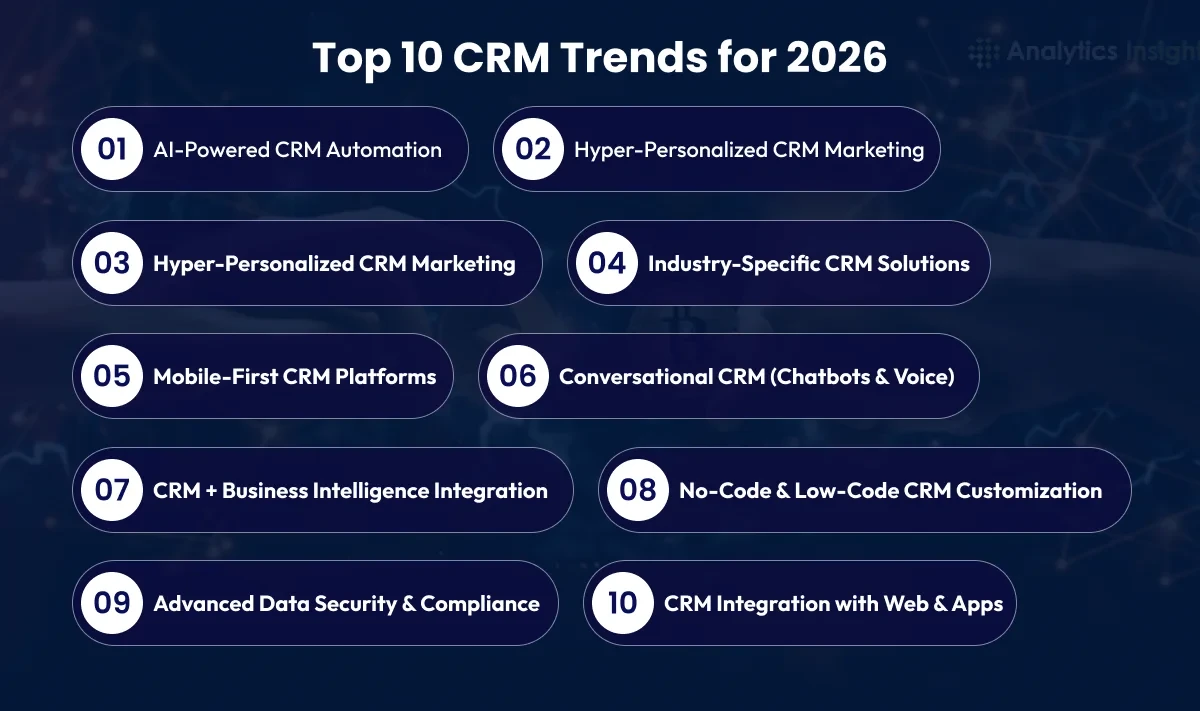
In 2026, customer relationship management is shifting from a passive database of customer interactions into an active, predictive operational engine. Enterprise platforms are moving past simple generative drafting toward autonomous multi-agent orchestration, proactive deal risk modeling, natural language interfaces, and outcome-based commercial licensing. Forrester analyst Kate Leggett confirmed this trajectory, stating that “CRM in 2026 is undergoing a structural shift, not just an incremental evolution,” as Gartner projects 40% of enterprise applications will embed task-specific AI agents by the end of 2026.
Revenue operations leaders, CIOs, and platform architects face a fundamental recalculation of their technology investments. Legacy software patterns that prioritized manual record-keeping and retrospective pipeline reporting no longer meet enterprise efficiency requirements. Navigating this environment requires understanding the architectural mechanics, procurement models, and governance guardrails that separate production systems from high-risk platform sprawl.
From Passive Records to Autonomous Systems
The defining CRM trend of 2026 is the transition from passive system-of-record databases to autonomous systems of action. Rather than requiring sales reps to manually log data, modern CRM software leverages autonomous agents to capture omni-channel interactions, forecast customer buying intent, and execute multi-step operational tasks directly across platforms.
Historically, enterprise CRM operated as a digital filing cabinet. Sales representatives manually entered conversation summaries, updated deal stages, and created pipeline tasks after customer meetings occurred. This historical model created persistent data lag and incomplete reporting across business units. Industry analysis from Frigat NET observes: “Modern CRM has already evolved beyond being a simple customer database. Today, it is a technological system that helps companies navigate data faster, build customer relationships more precisely, and use resources more rationally.”
The operational reality of agentic software has advanced from the experimental pilot phases of 2025 into standardized production rollouts. Gartner projections indicate that 80% of enterprises will have used or deployed generative AI in production by 2026. Rather than relying on human prompts to generate single-turn email drafts, production systems operate autonomously in the background. Autonomous CRM agents monitor client email exchanges, cross-reference external buying intent data, update deal qualification criteria, and orchestrate calendar scheduling across multiple stakeholder groups.
The following architectural comparison details how core operational pillars have evolved between legacy platforms and 2026 CRM deployments:
Operational Dimension |
Legacy CRM Architecture (Pre-2026) |
2026 Next-Generation CRM |
|---|---|---|
Operational Mode |
Reactive record-keeping triggered by manual human updates and static alert rules. |
Predictive, continuous background analysis that forecasts risk and purchase readiness. |
System Automation |
Point-to-point scripts and rule-based triggers requiring active user initiation. |
Autonomous multi-agent orchestration executing cross-functional tasks across systems. |
Commercial Model |
Strict per-seat monthly subscriptions tied directly to human user headcount. |
Hybrid pricing incorporating consumption tiers, active agents, and verified business outcomes. |
Interface Paradigm |
Tabular data grids, complex form navigation, and manual dropdown menus. |
Conversational interfaces powered by natural language prompts and voice-driven inputs. |
This structural change redefines the fundamental purpose of CRM software. Systems no longer serve solely as an administrative inspection tool for management; they function as active operational participants executing everyday revenue workflows.
How Multi-Agent Orchestration Replaces Departmental Silos
Multi-agent orchestration in 2026 connects specialized AI agents across sales, marketing, and customer service. Instead of relying on manual departmental handoffs or brittle API triggers, enterprise CRM agents autonomously pass context, route tasks, and trigger cross-functional workflows within shared digital workspaces while respecting predefined role permissions and operational guardrails.
Traditional revenue organizations frequently suffer from severe communication gaps between marketing, direct sales, and customer success teams. When sales, support, and billing operate in disconnected systems, teams waste time, make operational decisions with partial visibility, and run into manual reporting cycles. Specialized enterprise agents solve this operational breakdown by passing contextual work directly to one another across functional boundaries.
For example, when a marketing agent qualifies an enterprise prospect exhibiting high product usage signals, it routes an enriched opportunity file directly to a dedicated sales development agent. The sales agent evaluates account stakeholder history, drafts a contextual outreach sequence, and reserves meeting slots without human intervention. Gartner expects that by the end of 2026, more than 80% of enterprise sales cycles will involve at least one shared digital workspace, creating a collaborative environment where human teams and software agents collaborate on deal execution.
Deploying multi-agent architectures safely requires an operational supervision framework built on four foundational components:
- Context Synchronization: Shared semantic memory layers ensure that customer intent, historical touchpoints, and technical requirements remain consistent as tasks transition between specialized agents.
- Dynamic Task Assignment: Central orchestrators evaluate incoming triggers, verify agent availability, and route execution duties to the domain-specific agent best suited for the workload.
- Permission Verification: Cryptographic authorization layers validate that an autonomous agent holds appropriate system credentials before allowing data modifications in underlying databases.
- Immutable Audit Logging: Continuous telemetry records every inter-agent request, decision parameter, and external system call to provide total traceability for compliance and post-action analysis.
Predictive Forecasting Overtakes Static Automation
Static, rule-based CRM workflows are yielding to real-time predictive modeling. Where previous architectures depended on rigid if-this-then-that automation triggers—such as sending a standardized follow-up email three business days after a form submission—modern systems continuously analyze customer behavioral signals, sentiment, and pipeline velocity.
Forrester research shows that 70% of companies already deploy AI capabilities inside their CRM environments. The technical frontier has shifted from basic anomaly alerts to forward-looking predictive systems that evaluate deal patterns. Rather than waiting for a pipeline review to reveal a delayed sales cycle, machine learning models assess communication cadence, stakeholder engagement levels, and historical deal trajectories. The CRM identifies stalled opportunities and potential deal loss risks before sales leadership notices the slowdown.
Revenue operations teams also deploy continuous data enrichment layers to protect predictive scoring from synthetic noise. Automated outbound AI campaigns and generative form bots can flood pipeline databases with invalid interactions. By integrating real-time verification pipelines, modern CRM platforms filter out automated junk submissions, confirm verified corporate signals, and ensure predictive forecasting reflects authentic customer intent.
The Commercial Shift to Outcome and Agent-Based Pricing
The commercial economics of enterprise CRM software are separating from human employee headcounts. For over two decades, the per-seat monthly subscription served as the foundational monetization model for enterprise cloud software. As autonomous digital agents absorb operational workloads previously executed by human administrators, the economic link between software utility and employee license counts has broken down.
SaaS licensing models are shifting toward hybrid structures that combine base platform access with consumption metrics, agent-tier licensing, and outcome-based charges. Industry research values the global SaaS CRM market at $77.13 billion in 2026, with projections reaching $224.43 billion by 2035 at a compound annual growth rate (CAGR) of 12.60%. Market segmentation data reveals that public cloud deployments hold a dominant 70% market share as of 2025, with North America representing 38% of total revenue. Sales force automation (SFA) remains the largest functional category, holding a 30% share.
In April 2026, Salesforce executive Marc Benioff noted that AI strengthens SaaS business models by shifting focus to outcome-based metrics and deeper integration, rejecting predictions that enterprise software platforms would face revenue contraction as automation expands. As software vendors align billing with business outcomes—such as resolved support cases, qualified opportunities, or closed transactions—enterprise procurement teams must transition from fixed seat budgets to variable consumption forecasting with established spending caps.
A Governance Blueprint for Autonomous CRM Agents
Deploying autonomous software agents without operational guardrails exposes organizations to security liabilities, contract errors, and brand damage. When software agents interact directly with production databases and external clients, enterprise revenue operations teams must institute strict permission boundaries.
The Four-Tier Execution Matrix
To safely scale agentic automation, RevOps leaders should categorize all CRM workflows into four operational control tiers based on system impact, financial exposure, and client visibility.
Operational Tier |
Autonomy Level |
Permitted CRM Actions |
Safety Boundary & Escalation Trigger |
|---|---|---|---|
Tier 1: Informational |
Full Autonomy (Read-Only) |
Querying interaction history, summarizing account transcripts, analyzing buying signals. |
Zero write permissions. System outputs are strictly internal and contextual. |
Tier 2: Assistive |
Human Co-Pilot |
Drafting outreach emails, recommending pricing tiers, suggesting task assignments. |
Agent outputs require direct human review and approval before delivery. |
Tier 3: Human-in-the-Loop |
Conditional Execution |
Updating opportunity pipeline stages, issuing standard contract renewals, applying routine discounts. |
Actions execute automatically within preset boundaries; deviations require manager override. |
Tier 4: Autonomous |
Full Autonomy (Bounded Write) |
Deduplicating contact records, updating account addresses, scheduling verified calendar requests. |
Bounded to verified data fields; rate limits trigger administrative freeze if thresholds are exceeded. |
Establishing clear boundary conditions prevents runaway operational actions. As the matrix demonstrates, Tier 1 and Tier 4 workflows operate autonomously within strict technical parameters, whereas Tier 2 and Tier 3 actions enforce clear human approval requirements.
Enforcing Human-in-the-Loop Approval Thresholds
Boundary conditions must be enforced for customer-facing communications, discount authorizations, and contract generation. Academic and enterprise research on operational agents demonstrates real productivity gains: candidate relationship management agents reduced manual recruiter hours per hire by 30% to 50% in 2026 by automating routine sourcing, engagement, and profile verification. However, that same research emphasizes that final qualification and contract negotiations must remain human-governed.
Allowing unconstrained agents to negotiate pricing introduces corporate liability. If an autonomous agent erroneously commits to custom service-level agreements (SLAs) or excessive discount rates during an automated interaction, the enterprise remains legally bound by those terms. Implementing strict verification layers ensures that any proposal exceeding baseline pricing parameters routes immediately to executive sales management.
Natural Language Interfaces and Low-Code Workflows
Enterprise software interfaces are moving away from dense form fields, multi-level dropdowns, and rigid dashboard navigation. Frontline sales representatives and service agents interact with core systems through conversational prompts, voice dictation, and contextual summaries.
Major enterprise software providers have accelerated this shift across platform ecosystems. In January 2026, Salesforce expanded AI-driven platform capabilities to automate complex operational workflows and enhance predictive insights. Similarly, in March 2026, Microsoft upgraded Dynamics 365 with Copilot AI capabilities, introducing proactive sales recommendations, automated deal summaries, and conversational record updates. A field sales representative can dictate account updates, specify next steps, and trigger pipeline stage changes via voice while traveling, eliminating administrative logging backlogs.
Simultaneously, low-code and no-code tools permit business teams to adjust CRM workflows without waiting on developers. Rather than filing technical engineering tickets to alter lead routing rules or adjust territory scoring, revenue operations managers use drag-and-drop workflow builders. This flexibility enables organizations to adapt operational pipelines to shifting market conditions while maintaining standardized backend data schemas.
Why Successful Teams Are Choosing Micro-Implementations
Enterprise CRM initiatives frequently falter when organizations attempt comprehensive, multi-departmental transformations all at once. Piling complex automation layers on top of inconsistent sales processes or unverified customer records amplifies administrative friction instead of resolving it.
Warning: Over-Engineering Core Stacks Implementing advanced autonomous agents across unstandardized pipelines risks accelerating data corruption and user disengagement. Solve foundational pipeline mechanics before introducing multi-agent automation.
CRM practitioner Basil Malik emphasized a targeted strategy, noting that “less is more” when configuring enterprise software stacks. Teams that isolate primary friction points, automate them incrementally, and secure full user adoption achieve significantly higher success rates than organizations attempting broad, immediate platform overhauls.
Addressing the data layer, author Kevin Sun pointed out structural limits in behavioral tracking: “The challenge to create an individual from their quantifiable data still remains. The increasingly invasive nature of data collection is will likely unsustainable in the run.” Attempting to capture every possible consumer interaction creates data storage bloat and privacy friction without yielding proportional revenue insights. Successful revenue teams focus on high-fidelity, permissioned data collection that supports defined customer outcomes.
FAQ
How will agent-based pricing impact enterprise CRM software budgeting in 2026?
As autonomous software agents perform operational workflows previously tied to human roles, vendors are augmenting or replacing seat subscriptions with usage-, agent-, and outcome-based pricing. Procurement teams must model variable consumption costs, implement automated token spending caps, and evaluate software value on cost-per-resolution rather than budgeting solely on headcount.
Who is liable when an autonomous CRM agent commits an error during a deal cycle?
Enterprise legal frameworks hold the deploying organization fully responsible for commitments made by autonomous software. Organizations must implement strict operational guardrails, restricting autonomous execution to low-risk, internal data maintenance while routing binding commercial commitments, such as custom pricing and contractual agreements, through mandatory human approvals.
What is zero-copy architecture, and how does it affect CRM data storage?
Zero-copy architecture allows CRM platforms to query customer data directly from central cloud data warehouses without duplicating records into proprietary CRM databases. This approach eliminates synchronization delays, prevents inconsistent customer profiles across departments, and reduces the secondary storage fees traditionally charged by CRM platform vendors.
How can RevOps teams prevent synthetic AI leads from skewing predictive CRM scoring?
Teams must deploy automated data enrichment and verification filters at intake points. These layers evaluate incoming leads against authentic corporate registries, filter out bot-generated behavioral patterns, and verify email authentication protocols before allowing activity logs to impact predictive pipeline scoring models and forecast analytics.